
Long ago, in a service system far, far away…
Many leaders championed the Way of the Empire: a rigid, prescriptive model of practice and supervision. It promised consistency and accountability. However, in its quest for standardisation, it often stifled professional judgment. It also affected the very heart of client-centred care.
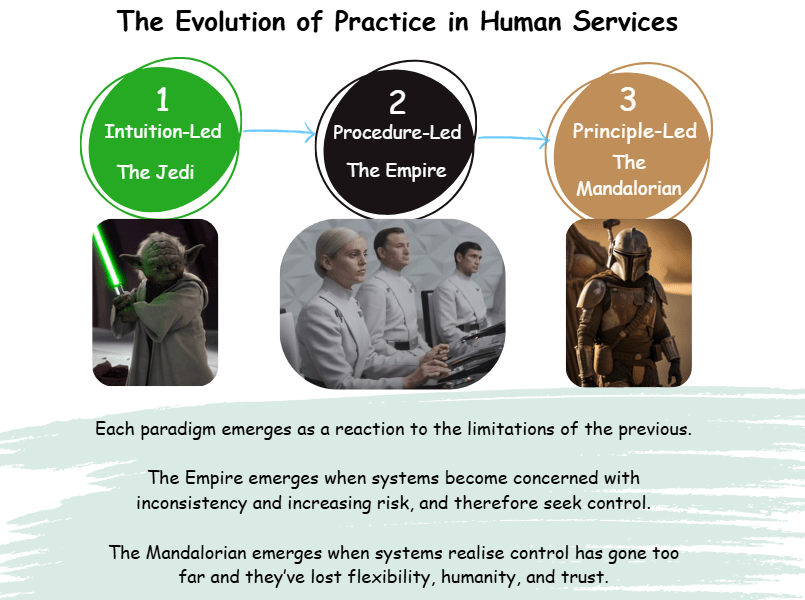
Yet the Empire didn’t emerge in a vacuum. It was a powerful reaction to the flaws of the old ways: the Way of the Jedi. This was an unregulated, intuitive approach where quality depended largely on a practitioner’s innate skill. While it allowed for profound artistry and connection, it was often inconsistent, poorly articulated, and difficult to scale or teach.
Each paradigm was a reaction against the other’s limitations, leaving the sector oscillating between the chaos of pure intuition and the rigidity of strict manualisation. However, our universe requires balance. Is there another path, you wonder, staring out toward Tatooine’s two suns?

Enter the Mandalorian. This is the way.
This blog will explore the evolution of practice in human services, and its search for a more sustainable, principled, and adaptive middle ground. Using a much-loved galactic metaphor, we will:
1. Unpack the Way of the Jedi
Explore its foundations in psychodynamic psychology. We’ll examine its strengths and profound legacy, but also the perils of practice as an art.
2. Analyse the Rise of the Empire
The sector’s well-intentioned overcorrection. We’ll explore the influence of New Public Management (NPM). We will also examine the rise of Evidence-Based Practice (EBP). Our goal is to understand how the drive for metrics and manualisation compromised the intended outcomes.
3. Chart a Course to the Middle Ground: The Way of the Mandalorian.
Here, we’ll explore a principled, adaptive path forward. We’ll unpack frameworks like the common elements approach and principled pluralism—proving that effectiveness doesn’t require choosing between a rigid script and pure instinct.
So, buckle in and switch on your conceptual hyperdrive. I’m yet to master Jedi mind reading, so please share your thoughts in the comments.
The Way of the Jedi
The early history of psychology was shaped by philosophical speculation and the artistry of pioneers who relied on intuition, deep observation, and introspection. Like the Jedi attuning themselves to the Force, these early thinkers trusted the unseen currents of the psyche more than any instrument or metric.
Among them, Sigmund Freud stands as the archetypal figure of this pre-evidence era. His psychodynamic model drew not from experiments but from the careful interpretation of dreams, slips of the tongue, and symbols. Behaviour, he believed, was shaped by the hidden energies of the unconscious, much as the Force shapes events in ways unseen.

This “artistry of practice” left an indelible mark on psychology, human services, and Western thought. Later traditions like the behavioural and cognitive schools brought scientific precision, but the early psychodynamic tradition emphasised the relational, interpretive, and deeply human side of healing.
Core Tenets of the “Artistic” Psychodynamic Approach
It’s crucial to define what “artistry of practice” meant:
The Therapeutic Relationship as the Primary Tool
Healing wasn’t seen as just applying a correct interpretation, but as emerging from a profound, authentic, and trusting relationship between therapist and client — a bond not unlike that of a Jedi and their Padawan, where trust and presence were everything.
Subjectivity and Intersubjectivity
The therapist’s feelings, reactions, and subjectivity (countertransference) were not seen as contaminants to be eliminated, but as vital sources of information about the client’s inner world and the relational dynamic. Like a Jedi sensing the disturbance in the Force, therapists used their own inner experience to navigate anothers emotional terrain.
The Unconscious and Symbolism
Dreams, metaphors, and slips of the tongue were seen as encrypted messages from the unconscious. To understand someone was to interpret these symbols — as if reading the Force itself for signs of imbalance or truth.
Focus on Meaning and Existential Concerns
The goal was not just symptom reduction, but helping individuals confront existential themes like freedom, purpose, and death, and to live more authentic, fulfilling lives — the same existential tensions that define the heroes and villains of every great saga.
Criticisms of the “Artistry”
By the 1970s, psychology — like the Jedi Order before the fall — faced a reckoning. The field struggled to prove its effectiveness and legitimacy in the face of growing demands for evidence, structure, and accountability. The “artistry” of the era meant that methods varied greatly between practitioners, and there was no consistent standard for evaluating the effectiveness of therapeutic approaches.
A survey of clinical psychologists found that one reason for resistance to evidence-based practice was a preference for clinical experience and intuition over empirical findings (Lilienfeld et al., 2013). This echoes Obi-Wan’s advice to Luke during the Death Star trench run: to “let go” and trust the Force rather than rely on his X-wing’s targeting computer.

Like the early psychodynamic pioneers, the Jedi elevated intuition and inner experience above measurement and method, valuing insight over instrumentation. Both traditions held a deep faith in the unseen — the unconscious or the Force — and in the practitioner’s ability to attune to it.
However, introspection is unreliable, untestable, and prone to bias. A cross-national study showed that the same patient could be diagnosed with schizophrenia in New York but with manic-depressive illness in London (Cooper et al. 1971). The 1980 release of the Diagnostic and Statistical Manual of Mental Disorders, Third Edition (DSM-III) marked a turning point, introducing clear diagnostic criteria and improving reliability across practitioners.
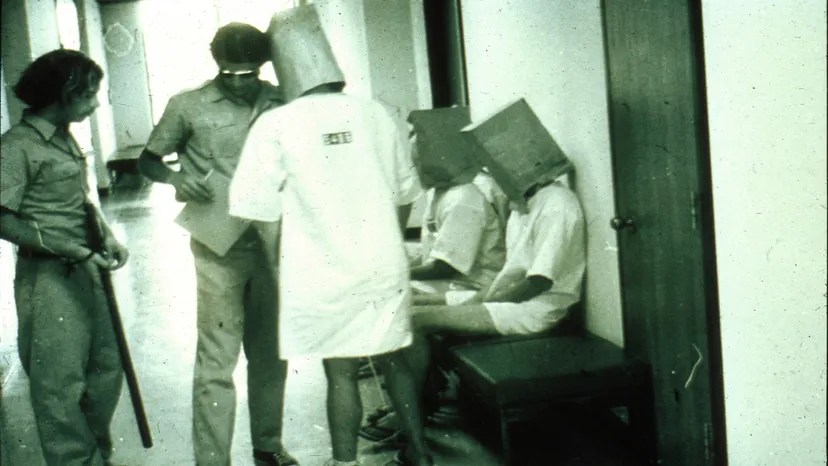
Around the same time, several influential experiments demonstrated a severe lack of ethical standards, which eventually led to stricter regulations. The infamous Stanford Prison Study (1971) was cut short after six days due to the psychological harm inflicted on participants who quickly adapted to the assigned roles of guard and prisoner.
Moreover, the psychodynamic approach often appeared elitist and inaccessible: expensive, lengthy, and cloaked in complex language. In this sense, it resembled the ancient Jedi Order — guardians of sacred texts, wise but insular, their wisdom bound in traditions only a few could master.

As with the Jedi, this reliance on artistry and intuition made psychodynamic practice difficult to teach and replicate. Like the Jedi, each master had one apprentice. Scaling such a model was impossible — and the galaxy soon demanded more uniform, replicable ways of healing.

Social work had its own “effectiveness crisis” in the 1970s. A series of studies questioned the effectiveness of existing social work interventions, leading to the development of empirical-clinical practice models.
By the 1980s, social work educators were expected to become more active researchers to develop and test interventions. The decade also saw an increased focus on interdisciplinary collaboration, as social workers recognised that complex problems required a multifaceted approach. This encouraged collaboration with other professionals and the use of evidence to inform intervention strategies.
These foundational issues in psychology and social work became the catalyst for the modern, evidence-based practices used today.
Enter Order 66 and the Jedi Purge…

The Way of the Empire
The mid-20th century saw a gradual shift toward more empirical and scientific approaches in psychology and human services more broadly, moving away from the reliance on intuition and introspection that characterised the pre-evidence era. Behavioural and cognitive approaches, with their emphasis on observable behaviour and scientific experimentation, emerged as a reaction to the subjectivity of structuralism and psychodynamic theory.
The Rise of the Empire: Standardisation, Evidence-Based Practice, and New Public Management
The push for standardisation, Evidence-Based Practice, and New Public Management did not emerge from a void. It was, in many ways, a necessary and righteous response to a past where practice was often unaccountable, where clients could be harmed by untested methods, and where the absence of oversight meant people could fall through the cracks.
These systems were built with the noble intention of protecting the vulnerable from the potential whims and incompetence of unchecked practitioners—to replace a chaotic and sometimes dangerous frontier with a safe and reliable republic.

By the late 20th century, health and community services faced mounting pressure to prove their effectiveness. Governments and funders wanted results that could be measured, benchmarked, and reported. The artistry of intuition gave way to the authority of data. In psychology, this manifested as the rise of Evidence-Based Practice (EBP). In management, it came cloaked in the polished armour of New Public Management (NPM) — a technocratic vision of efficiency, metrics, and managerial oversight.
Both movements sought to bring order to the galaxy.
Evidence-Based Practice: A New Hope (for Accountability)
On paper, EBP promised balance—integrating research evidence, clinical expertise, and client values. It aimed to protect people from the untested methods and interpretive excesses of earlier eras. It professionalised the field, established ethical guardrails, and built trust in an increasingly skeptical public.
In practice, however, the ideal often fell prey to its own bureaucracy. What began as a noble cause gradually transformed into a kind of clinical imperialism, where only certain forms of knowledge counted as legitimate.
If the psychodynamic pioneers were Jedi mystics trusting the living Force, then the EBP movement was the rise of the Galactic Senate — committees, protocols, and systematic reviews deciding which truths would be recognised as legitimate.
The Tyranny of the Manual
Forms of practice that couldn’t be easily measured — relational work, community development, narrative therapy — were often sidelined as “unscientific.” The result: a sector that valued fidelity to manuals over flexibility with people.
Research shows that this rigid adherence can damage the therapeutic relationship, which is consistently found to be one of the most significant factors in positive client outcomes. A study found that front-line providers reported protocol-driven care often conflicted with client-centred care, forcing them to choose between fidelity to a model and the individual needs of the person in front of them (Forbat et al., 2014; Mansfield & Addis, 2001).
The Narrowing of Evidence
The hierarchy of evidence that prizes Randomised Controlled Trials (RCTs) above all else can exclude the very wisdom needed for complex, real-world situations. As Obi-Wan said to Anikan, “Only a Sith deals in absolutes.” Yet, by sidelining qualitative and experiential knowledge, systems risk becoming ineffective.

A critique in the Journal of Social Work argues that an over-reliance on EBP can lead to “epistemic injustice,” where the knowledge of both clients and practitioners is discredited, ultimately reducing the profession’s ability to respond meaningfully to human suffering (Webb, 2001).
New Public Management: The Bureaucratic Turn
While psychologists debated what counted as “evidence,” the broader sector underwent its own transformation. The 1980s saw the rise of New Public Management (NPM) — a governance philosophy that borrowed business principles and applied them to public services.
Efficiency became the new virtue. Performance indicators replaced professional discretion. The once messy, relational nature of care was recoded into Key Performance Indicators (KPIs), output measures, and client throughput.
Like Imperial stormtroopers, agencies began to look identical — structured for consistency, trained for compliance, and rewarded for uniformity. The goal was to standardise and scale good practice — but often at the cost of creativity, autonomy, and relational depth.
The Jedi healers of the mind and heart were replaced by bureaucrats armed with spreadsheets and audit tools.


The language shifted, too. Clients became “service users” and healing became “service delivery.”
The Human and Organisational Cost
The Rise of Burnout
The NPM regime has been directly linked to a crisis in workforce wellbeing. Studies revealed that the intense performance monitoring, target culture, and reduction of professional autonomy inherent in NPM are key drivers of stress, burnout, and “de-professionalisation” among public service workers (Blomqvist et al., 2014; Ravalier et al., 2014). Practitioners are left with less time for clients and more time for paperwork, leading to emotional exhaustion and cynicism.
The Paradox of Organisational Ineffectiveness
Crucially, this standardisation often fails in its own terms: it reduces organisational effectiveness. Research shows that to cope with impossible metrics and complex human needs, workers develop informal “coping mechanisms”—such as rationing services, creaming (selecting the easiest clients), or manipulating data—that ultimately undermine the policy goals of the very system they serve (Tummers et al., 2015). The system, designed for control, loses touch with reality.
Are Clients Safer?
Despite the use of evidence-informed standardised risk management tools:
Wide variation in professional judgements seem to persist even when using the best of current standardised risk assessment measures (Høybye-Mortensen, 2015; Regehr et al., 2010).
Further, the imposition of ever more complex ‘comprehensive’ frameworks for managing risk decisions is becoming excessively burdensome for frontline professionals and considered counter-productive (Munro, 2009).
They can involve exhaustive lists of possible risk factors (sometimes 30 – 40), which tend to be overly formalised and mechanistic, based on the notion that risk can be accurately predicted and managed (Parton, 1996).
Some critics argue contemporary risk management tools are not primarily designed to improve people’s lives but is to demonstrate professional diligence/competence to minimise professional and organisational liability (Finlayson, 2016).
The Promise and the Price of Order
To be fair, the Empire had its logic. Systems became safer in some ways. Accountability improved. Resources could be allocated more equitably. Fewer people fell through the cracks of idiosyncratic or unethical practice.
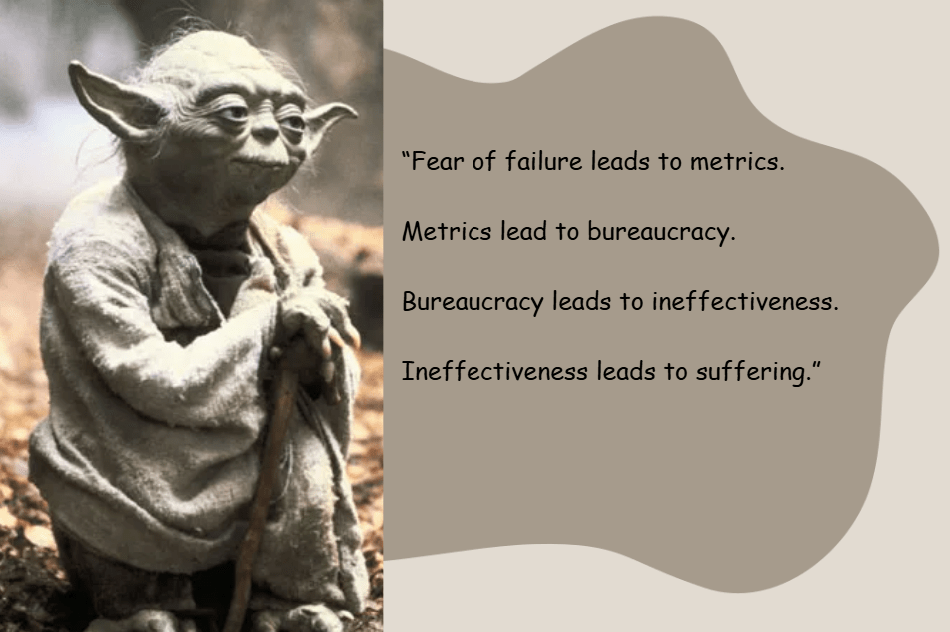
But, as history (and the Star Wars canon) remind us, order without wisdom leads to decay. Over time, NPM and rigid EBP began to produce a kind of technocratic fatigue — practitioners spending more time proving they were effective than actually being effective.
The relational art of practice, once central, risks extinction under the weight of the very systems meant to support it.
As Yoda might say…
The Way of the Mandalorian: This is the Way
Every era eventually swings back toward balance. Even within the Empire’s rigid bureaucracy, rebels operated—practitioners who questioned the tyranny of the spreadsheet and quietly championed the human, relational side of practice.
Today, a new synthesis is emerging, one that ends the futile war between the art of intuition and the science of evidence. Effective care needs both the Jedi’s heart and the Empire’s data — but rejects the dogma of both. It is neither a solitary mystical journey nor an impersonal imperial protocol.
Enter the Mandalorian. This is the Way
Mandalorian culture represents this adaptive, principled middle ground. They are not bound by the Jedi’s rigid dogma nor the Empire’s soulless bureaucracy. Instead, they live by a core, honour-bound code—The Resol’nare—an ethical compass both unbreakable and practical. How they apply this code, however, is fiercely practical, adaptable, and tailored to the challenge at hand.
In human services, this philosophy is embodied by two powerful frameworks:
- Common Elements Approach
- Principled Pluralism.
The Common Elements Approach: Our Weapons and Our Skills
The Common Elements Approach is the Beskar armour of effective practice. Rather than swearing allegiance to a single, manualised model—the Jedi’s lightsabre or the Imperial protocol—it focuses on the fundamental, cross-cutting skills and techniques that actually drive change, proven to work across many different models.
Where the Empire might demand fidelity to one specific manualised approach, a Mandalorian-inspired practitioner is trained to deploy multiple approaches (i.e. trauma-integrated engagement or coaching) as the situation demands.
“Weapons are part of my religion,” Mando quips; yet he rarely uses one the same way twice.

This approach is deeply empirical. Chorpita’s research systematically shows that mastering these core components can outperform rigid adherence to any single branded treatment (Chorpita et al., 2005). It respects evidence but liberates it from bureaucratic standardisation.
Principled Pluralism: This is the Way
Principled Pluralism provides the ethical and practical code—the “This is the Way” mantra. It holds that no theory has a monopoly on truth. Effective practice involves thoughtfully integrating multiple perspectives (pluralism) while being guided by a firm set of ethical and empirical principles.
A flexible creed, not a rigid law. Like Din Djarin removing his helmet to save Grogu, sometimes principle demands breaking form. Practitioners guided by this code ask not, “What manual do I follow?” but “What does this person, in this moment, need?”

A direct violation of his creed—but done for love and ethical necessity.
Perfect illustration of principled flexibility.
Such a practitioner might draw on a psychodynamic understanding of a client’s history, use a cognitive-behavioural technique for a specific problem, and employ narrative therapy to help re-author their story—all within a single, coherent relationship.
This framework rejects both clinical imperialism and bureaucratic reductionism (Harvey, 2021). It values professional judgment and human connection—the very qualities that turn a worker into an instrument of change.
The Mandalorian Supervisor and Practitioner in Action
“This is the Way” Mantra
Their principle is client wellbeing, not protocol compliance. Their “creed” is a commitment to using the best available evidence, clinical expertise, and client voice in tandem.
Combat Adaptability
They are skilled in multiple “fighting styles” (theoretical models) and can shift strategies fluidly based on client feedback and progress, much like the adaptability of the Mandalorian in combat.
Clan and Tribe Structure
They thrive in collaborative, multidisciplinary teams, sharing knowledge and supporting one another, contrasting with the isolated Jedi or the interchangeable Imperial stormtrooper.
Armor as Resilience
Their Beskar is their strong therapeutic alliance—the most evidence-based factor for positive outcomes—which protects the healing space from the corrosive pressures of bureaucracy.
Conclusion
The Way of the Mandalorian is an integrative approach, where a human services supervisor or practitioner might use the relational, empathic foundation of the “artistic” model to build a strong alliance, while incorporating more structured, evidence-based techniques from other models to facilitate change. The legacy, therefore, is not a preserved relic but how we understand and practice the art and science of healing.
The new frontier is not about choosing a side but about forging a new path. It is the path of the resilient, principled, and adaptive supervisor or practitioner who carries the wisdom of the past without being bound by its dogma.
This is the Way.

References
Blomqvist, P., & Winblad, U. (2022). Have the welfare professions lost autonomy? A comparative study of doctors and teachers. Journal of Social Policy, 53(1), 64–85. https://doi.org/10.1017/S0047279420000585
Chorpita, B. F., Daleiden, E. L., & Weisz, J. R. (2005). Modularity in the design and application of therapeutic interventions. Applied & Preventive Psychology, 11(1), 141–156.
Cooper, J. E., Kendell, R. E., & Gurland, B. J., et al. (1970). Cross-national study of diagnosis of mental disorders: Hospital diagnoses and hospital patients in New York and London. Comprehensive Psychiatry, 11(1), 18–25.
Finlayson, S. (2016). Stop worrying about risk – and start talking about worries. The Centre for Welfare Reform.
Forbat, L., Black, L., & Dulgar, K. (2014). What clinicians think of manualized psychotherapy interventions: Findings from a systematic review. Journal of Family Therapy, 37(4), 318‑341. https://doi.org/10.1111/1467-6427.12036
Harvey, D. (2021). Principled Pluralism and the Future of Social Work. The British Journal of Social Work.
Høybye-Mortensen, M. (2015). Decision-making tools and their influence on caseworkers’ room for discretion. British Journal of Social Work, 45(2), 600-615. https://doi.org/10.1093/bjsw/bct144 OUP Academic+2ucviden.dk+2
Lilienfeld, S. O., Ritschel, L. A., Lynn, S. J., Cautin, R. L., & Latzman, R. D. (2013). Why many clinical psychologists are resistant to evidence-based practice: Root causes and constructive remedies. Clinical Psychology Review, 33(7), 968–978. https://doi.org/10.1016/j.cpr.2013.06.004
Mansfield, A. K., & Addis, M. E. (2001). Manual‑based psychotherapies in clinical practice Part 1: assets, liabilities, and obstacles to dissemination. Evidence Based Mental Health, 4(3), 68‑72. https://doi.org/10.1136/ebmh.4.3.68
Munro, E. (2009). Managing societal and institutional risk in child protection. Risk Analysis, 29(7), 1015–1023. https://doi.org/10.1111/j.1539-6924.2009.01204.x
Parton, N. (1996). Social work, risk and “the blaming system”. In N. Parton (Ed.), Social theory, social change and social work (pp. 98–114). Routledge.
Ravalier, J. M., McVicar, A., & Munn‑Giddings, C. (2014). Changes in stress and burnout in public sector employees over 12 months. Work: A Journal of Prevention, Assessment & Rehabilitation, 48(4), 503–510. https://doi.org/10.3233/WOR-131794
Regehr, C., LeBlanc, V., Shlonsky, A., & Bogo, M. (2010). The influence of clinicians’ previous trauma exposure on their assessment of child abuse risk. The Journal of Nervous and Mental Disease, 198(9), 614-618. https://doi.org/10.1097/NMD.0b013e3181ef349e
Strickland, J. C., & Stoops, W. W. (2019). The use of pragmatic and pluralistic approaches to therapy in applied psychology. Journal of Contextual Behavioral Science, 12, 1-8.
Tummers, L. G., Weske, U., Bouwman, R., & Grimmelikhuijsen, S. G. (2016). The impact of red tape on citizen satisfaction: An experimental study. International Public Management Journal, 19(3), 320–341. https://doi.org/10.1080/10967494.2015.1027800
Webb, S. A. (2001). Some considerations on the validity of evidence-based practice in social work. British Journal of Social Work, 31(1), 57-79. https://doi.org/10.1093/bjsw/31.1.57
 The Cultural Nomad
Leave a comment