DeepSeek, China’s AI start-up, released its V3 model in December 2024. The company claimed it outperformed U.S. industry-leading models, such as GPT-4, but required fewer advanced chips and cost a fraction of the price.
By January 2025, DeepSeek released its first free chatbot app. Two weeks later, it surpassed ChatGPT as the most downloaded free app on the Apple store. DeepSeek’s perceived potential was so significant that chip-making giant Nvidia lost almost $600bn of its market value. This was the largest single-day loss in U.S. history.
Various companies, including Amazon Web Services, Toyota, and Stripe, sought to adopt DeepSeek while Western governments scrambled to ban it.
While researching DeepSeek’s emergence, I noticed parallels to China’s Rare Earth Elements (REEs) strategy of the 1980s and 90s. This strategy eventually led to China’s dominance and U.S. reliance, creating a major national security risk for the latter. (See my blog—https://cultural-nomad.org/2024/12/01/what-the-falafel-us-dependance-on-china-ree/)
So, is China’s AI strategy a little bit of history repeating?
This blog will explore:
- What is DeepSeek, and who’s behind it?
- Is DeepSeek an AI disruptor?
- What are the doubters saying?
- China, the U.S. and the race for AI supremacy
- REE parallels: A little bit of history repeating?
What is DeepSeek, and who’s behind it?
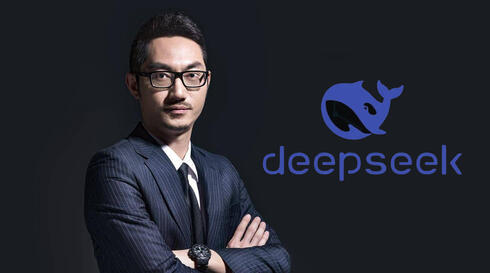
DeepSeek is a Chinese AI company founded in 2023 by Liang Wenfeng, co-founder of the hedge fund High-Flyer. It was initially conceived as High-Flyer’s Artificial General Intelligence (AGI) research division, which has utilised AI in trading algorithms since 2021. However, as of May 2023, DeepSeek has operated independently, with High-Flyer now one of its leading investors.
DeepSeek’s primary U.S.-based competitors include OpenAI, Google, and Meta and like its competitors, it is based on two main systems:
- Large Language Model (LLM)
- Reasoning Model
LLMs are trained on large amounts of text data using machine learning techniques, such as natural language processing. They can comprehend and generate human language by learning patterns and rules, enabling them to:
- predict the next word or sequence of words based on the given context
- imitate the writing style of a specific author or genre
- understand sentiment through analysis
Reasoning models perform complex reasoning tasks by producing responses incrementally, like how people reason through challenges or ideas. This process is referred to as a “chain of thought.” Current reasoning models perform on par with PhD students in physics, chemistry, and biology. They surpass the capabilities of PhD students in math and coding.
| Large Language Model (LLM) | Reasoning Model | |
| DeepSeek | V3 | R1 |
| OpenAI | GPT-4o | 01 |
DeepSeek caused shockwaves through the AI industry. It claimed it was built at a fraction of the cost of industry-leading models like OpenAI. This is because it uses fewer advanced chips.
This challenged the widely held belief that sophisticated large models depended on massive computing power. This was a critical development given China’s dependence on U.S. chips and the export bans preventing advanced chips from entering the country.
Is DeepSeek an AI disruptor?
Media outlets have used various terms to describe DeepSeek’s impact, including China’s AI Shock… game changer… changed AI forever. But does the rhetoric match the reality?
Much of DeepSeek’s hype is due to its cost-efficiency claims for its V3 model compared to competitors.
| Training Cost (million) | GPU Requirements | |
| DeepSeek V3 | $5.576 | 2,048 GPUs |
| Open AI GPT-4 | $100 | 16,000 GPUs |
| Efficiency Margin | $94.424 Cheaper | 13,952 fewer GPUs |
DeepSeek claims that in addition to achieving comparable performance with significantly fewer chips, they used the less advanced NVIDIA H800 GPUs instead of the superior H100.
While many have accused DeepSeek of merely copying OpenAI’s ChatGPT, the Diplomat argues there’s “genuine innovation” behind their achievements. Their machine learning algorithms:
enhances traditional attention mechanisms by using low-rank compression of key and value matrices. This drastically reduces the Key-Value (KV) cache size, resulting in a 6.3-fold decrease in memory usage compared to standard Multi-Head Attention (MHA) structures, thereby lowering both training and inference costs.
What are the doubters saying
Based on a review of articles and blogs, the doubters’ arguments can be themed into:
- The true cost is underrepresented
- DeepSeek is a development as opposed to a disruption
- DeepSeek used banned chips and copied ChatGPT
- Privacy/security concerns and the influence of the State
The true cost is underrepresented
In a CNBC article, Paul Triolio of DGA Group stressed it was difficult to compare DeepSeek’s development costs to U.S. competitors because:
The 5.6 million figure for DeepSeek V3 was just for one training run, and the company stressed that this did not represent the overall cost of R&D to develop the model.
Similarly, Kai-Shen Huang argues that the reported cost of $5.576 million relates to DeepSeek’s V3 model and doesn’t include the R1 model and associated expenses related to architecture development, data, and prior research.
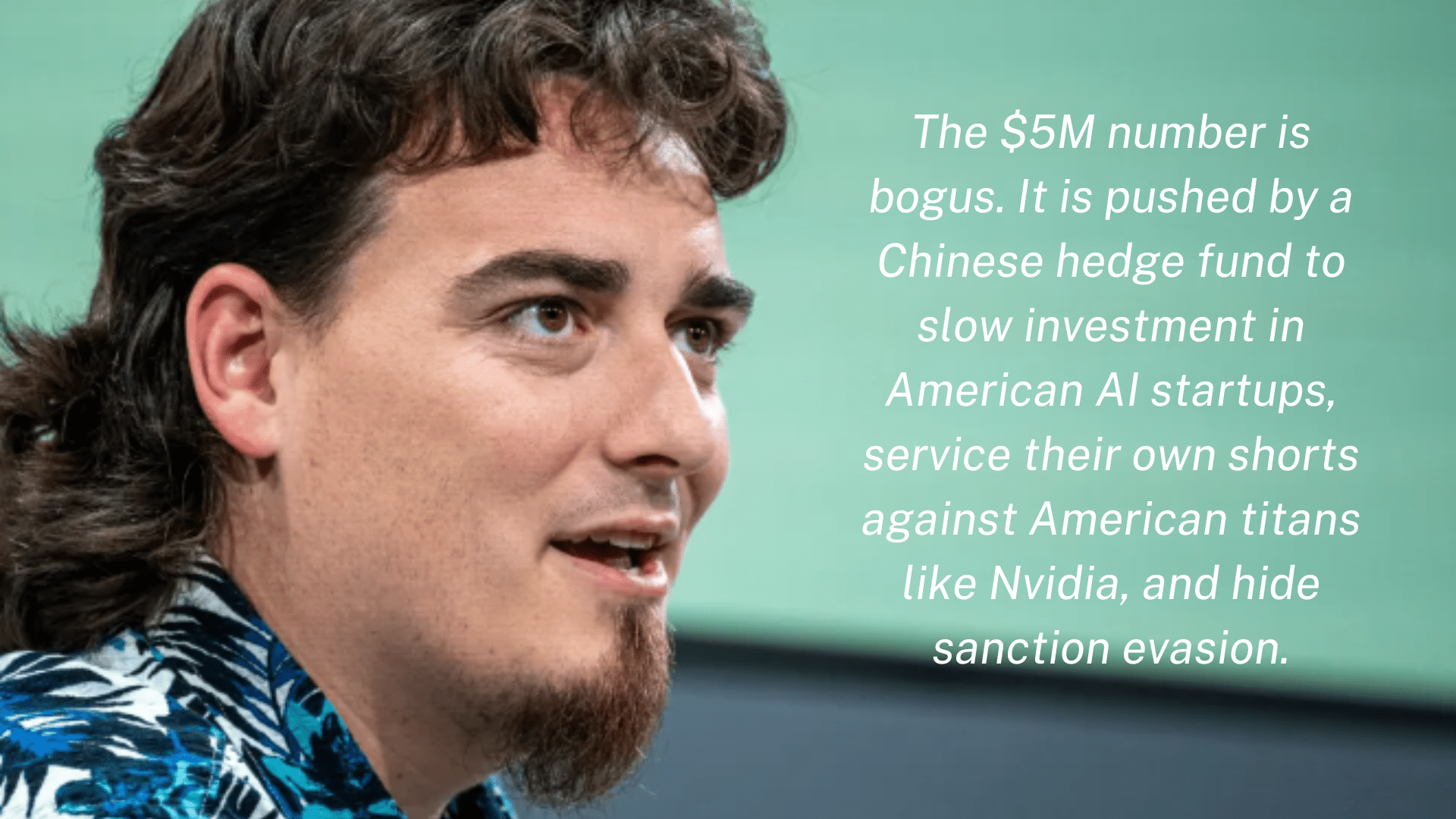
According to U.S. entrepreneur Palmer Luckey, founder of Oculus and Anduril:
DeepSeek is a development as opposed to a disruption
Kai-Shen Huang, writing for The Diplomat, argues the DeepSeek achievements:
may just represent iterative enhancements in the field of AI rather than a disruptive leap that could shift the overall balance of technological power.
They suggest that the first version of any innovation generally comes with high costs. Eventually cost-reducing solutions are introduced. This enables late adopters, especially in regions like China, to swiftly embrace these developments and close the gap with leaders at a lower cost. Therefore, U.S. AI companies could adopt these cost-reducing innovations themselves to increase their competitiveness.
DeepSeek used banned chips and copied ChatGPT
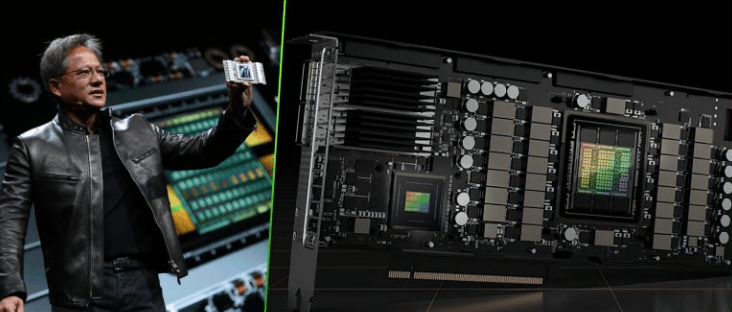
DeepSeek claims it achieved its breakthrough using Nvidia’s H800 and A100 chips. According to the BBC, Wenfeng massed up to 50,000 A100 chips prior to their export ban to China in September 2022. This enabled him to develop powerful AI models by combining them with lower-grade, cheaper chips. These chips are less advanced than Nvidia’s state-of-the-art H100 chips, which went into production after the ban.
However commentators, including Alexandr Wang, Scale AI CEO, accused DeepSeek of using prohibited chips. DeepSeek denies this claim, and Nvidia released a statement saying that DeepSeek’s GPUs were fully export-compliant.
Additionally, OpenAI, the creator of ChatGPT, announced that it is investigating DeepSeek for allegedly training its chatbot using ChatGPT’s data. In a statement to CNBC, OpenAI confirmed it is reviewing reports suggesting that DeepSeek may have inappropriately utilised output data from its models to develop its own AI. This practice is known as distillation.
Privacy/security concerns and the influence of the State
Western countries often harbour suspicion related to Chinese technology. For example, Huawei (telecom firm) and TikTok are subject to restrictions based on data, privacy, and national security grounds.
Australia has banned DeepSeek from all government devices and systems. In response, the Chinese foreign ministry released a statement describing the ban as the “politicisation of economic, trade and technological issues.” In the statement, they also vehemently denied DeepSeek was being used to collect data.
The Chinese government … has never and will never require enterprises or individuals to illegally collect or store data.
Authorities in the United States, South Korea, Ireland, and France have initiated investigations. They want to understand how DeepSeek manages user data, which is stored locally on servers in China. Meanwhile, the U.S. Navy has already banned its members from using DeepSeek.
According to the BBC, DeepSeek is trained to avoid politically sensitive questions. For instance, when I asked:

The BBC article suggested that Chinese government censorship complicates their international AI aspirations.
China, the U.S. and the race for AI Supremacy
In 2017, China’s government tabled the New Generation AI Development Plan, seeking to become the world’s major AI innovation centre by 2030. President Xi Jinping has declared AI a top priority. China aims to move away from traditional manufacturing, such as clothes and furniture, to advanced technology.

Accordingly, DeepSeek is a major win for the Chinese government. The Chinese state media declared that Silicon Valley and Wall Street were “losing sleep” over DeepSeek, which was “overturning” the US stock market.
Hu Xijin, a nationalist commentator, declared on social media:
DeepSeek has shaken the myth of the invincibility of U.S. high technology.
Marina Zhang, an associate professor at the University of Technology Sydney, told the BBC:
The company’s success is seen as a validation of China’s Innovation 2.0, a new era of homegrown technological leadership driven by a younger generation of entrepreneurs.
President Donald Trump referred to DeepSeek as a “wake-up call” for U.S. companies who must prioritise “competing to win”.
DeepSeek’s achievements raise questions regarding the need for extensive computing power in AI models. Is the premium for advanced chips justified, and does China need to depend on the U.S. for them?
REE parallels: A little bit of history repeating?
Rare earth elements (REEs) are used in missiles, wind turbines, medical devices, power tools, mobile phones, and motors for hybrid and electric vehicles.

From the mid-1960s to the 1980s, the U.S. controlled the REE market mainly through the Mountain Pass mine. However, cost, environmental, and regulatory pressures resulted in companies exploring alternatives or moving their industries to China. While China was initially slower in developing its REE operations, this changed in the mid-1970s, coinciding with the closing of mines in the U.S.
According to a 2018 Department of Defense report, China “strategically flooded the global market” with REE at lower prices to discourage current and future competitors. Analysts view this as a failed U.S. strategy, as China’s low costs, driven by subsidies and lax standards, outpaced the U.S. REE industry.
This eventually led to China’s dominance of REEs and U.S. dependence, posing a national security threat, which they are now scrambling to address.
So, is China flooding the global market with cheaper AI to discourage current and future competitors?
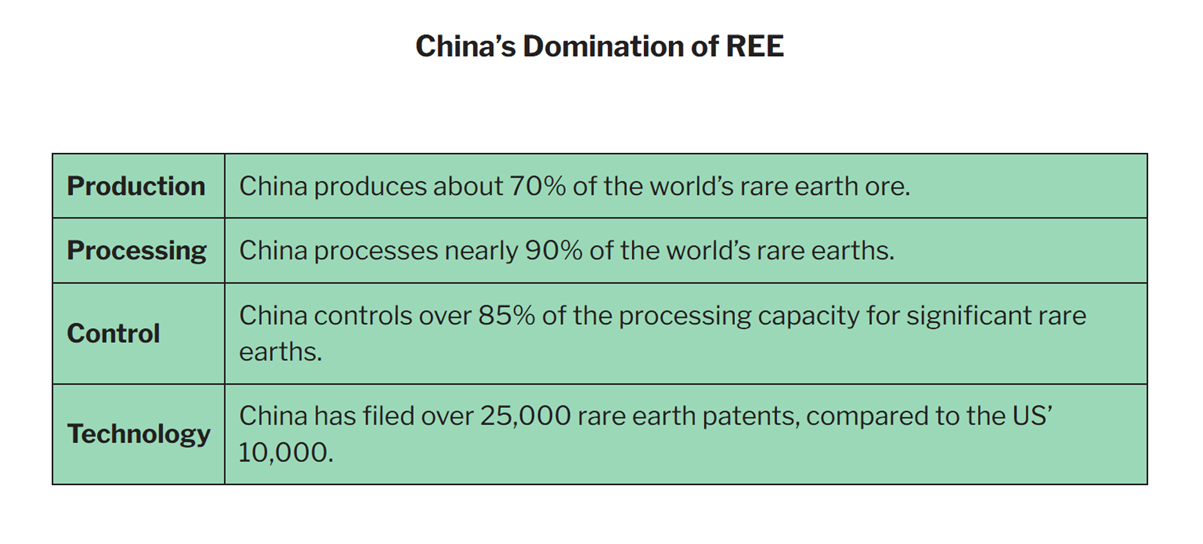
In conclusion, China is initiating a global AI price war. For the U.S. and its allies, the emergence of high-performing and cost-effective Chinese AI services threatens the local growth of AI industries. This may cause local AI investment to constrict. Or worse, it may lead to abandoning them in favor of cheaper Chinese solutions, reminiscent of past dumping tactics seen with REEs.
As in the case of REEs, China’s pricing advantage in AI is unlikely solely driven by innovation. Non-market factors like government subsidies may significantly give China a competitive edge.
So, has the U.S. learnt from their REE lesson, or will history repeat itself?
References
ABC News. (2025, Feb 6). China slams Australia’s DeepSeek ban on government devices. https://www.abc.net.au/news/2025-02-06/china-slams-australian-deepseek-ban-on-government-devices/104902664
Browne, R. & Butts, D. (2025, Jan 31). DeepSeek’s AI claims have shaken the world — but not everyone’s convinced. CNBC https://www.cnbc.com/2025/01/30/chinas-deepseek-has-some-big-ai-claims-not-all-experts-are-convinced-.html
Burrows, I. (2018, Oct 6). Made in China 2025: Xi Jinping’s plan to turn China into the AI world leader. ABC News. https://www.abc.net.au/news/2018-10-06/china-plans-to-become-ai-world-leader/10332614
Gerken, T. (2025, Feb 4). Australia bans DeepSeek on government devices over security risk. BBC. https://www.bbc.com/news/articles/c8d95v0nr1yo
Huang, K-S. (2025, Jan 1). China’s AI shock? What DeepSeek disrupts (and doesn’t). The Diplomat. https://thediplomat.com/2025/01/chinas-ai-shock-what-deepseek-disrupts-and-doesnt/
Ng, K., Drenon, B., Gerken, T., & Cieslak, M. (2025, Jan 21). DeepSeek: The Chinese AI app that has the world talking. BBC. https://www.bbc.com/news/articles/c5yv5976z9po
Schuman, M. (2025, Feb 4). DeepSeek and the truth about Chinese tech. The Atlantic. https://www.theatlantic.com/international/archive/2025/02/deepseek-ai-china-tech/681553/
Woodie, A. (2025, Feb 6). What Are Reasoning Models and Why You Should Care. HPC Wire. https://www.hpcwire.com/2025/02/06/what-are-reasoning-models-and-why-you-should-care/
 The Cultural Nomad
Leave a comment