
Was Freud’s conceptualisation of the unconscious mind part of our age-old effort to explain the relationship between the seen and unseen worlds?
The Unseen World
In her work Islam, Arabs, and the Intelligent World of Jinn, Amira El-Zein argues that throughout history, cultures have believed in an unseen world that influences the visible world. She writes,
“Cultures across the ages have conceived of an unseen world that impacts people’s lives in the visible world” (El-Zein, 2009).
The concept of the jinn is repeatedly addressed in the Quran, often in parallel with humanity. For example, the Quran states:
“And I did not create the jinn and humans except to worship Me.” (Surah Adh-Dhariyat, Verse 56)
The Quran also describes the origins of the jinn:
“And We did certainly create man out of clay from an altered black mud. And the jinn We created before from scorching fire.” (Surah Al-Hijr, Verses 26&27)
According to Islamic teachings, Muslims recognise the potential influence of the jinn from the unseen world in their lives, with some jinn attempting to affect human destinies. Early Muslim scholars associated the composition of the jinn—being made of fire—with intense emotions and powerful, often uncontrollable feelings (El-Zein, 2009).
Like many other cultures, Islam envisions the unseen world as being far more expansive than the visible world. The Prophet Muhammad (SAW) mentions:
“God divided the jinn and humans into ten parts: one part makes up the human race, and the other nine parts make up the jinn.”
The Unconscious Mind
The term unconscious was first introduced by philosopher Friedrich Schelling in the late 18th century and later popularised in English by poet Samuel Taylor Coleridge. In the field of psychology, the unconscious was initially explored by William James and Wilhelm Wundt, but it was Sigmund Freud who brought the concept to prominence, making it central to his psychoanalytic theory.
According to Freud, the unconscious is the primary force shaping human behaviour. It stores our emotions, thoughts, instincts, memories, and desires that are too threatening or socially unacceptable to be acknowledged consciously. The unconscious, therefore, operates outside of our conscious awareness, influencing our decisions and actions.
A commonly used metaphor to describe the unconscious is that of an iceberg, with the bulk of the mind—like the submerged part of the iceberg—lying hidden beneath the surface of conscious awareness.
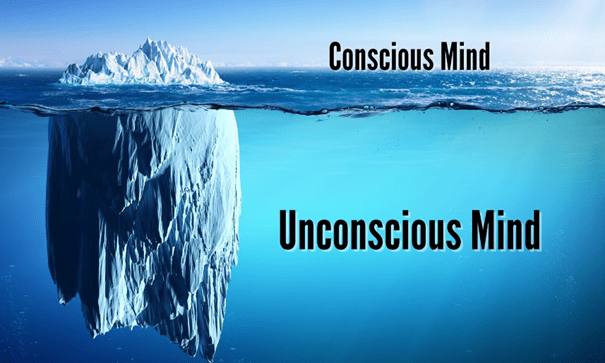
Everything above the water represents conscious awareness, while everything below the water symbolises the unconscious. Interestingly, according to the U.S. Geological Survey, 90% of an iceberg lies below the waterline, while only 10% is visible above the surface (USGS, 2024).
Freud believed that the unconscious mind stores powerful thoughts, beliefs, and emotions, which can potentially cause difficulties in one’s life. These include:
- Anger
- Bias
- Compulsive behaviours
- Difficulty with social interactions
- Emotional distress
- Relationship problems
(Cherry, 2023)
Although psychology has evolved beyond many of Freud’s theories, Bargh and Morsella (2008) argue that:
“Cognitive and social psychological evidence does support Freud’s view on the existence of unconscious mentation and its potential to influence judgments and behavior.”
Coincidence?
There are intriguing parallels between the world of the jinn and Freud’s description of the unconscious mind.
- The Relative Size
Freud believed that the unconscious mind is much larger than the conscious mind. Using the iceberg metaphor, the portion of the iceberg above the waterline (representing the conscious mind) to the much larger submerged portion (representing the unconscious) is roughly 10% to 90%. Similarly, the Prophet Muhammad (SAW) said:
“God divided the jinn and humans into ten parts. One part makes up the human race, and the other nine parts make up the jinn.” (10% to 90%)
- The Nature and Direction of Influence
Freud argued that the unconscious mind influences and often directs our conscious thoughts and behaviours, sometimes in harmful or destructive ways. In a similar vein, Muslims recognise that the jinn can influence human lives. Since jinn are composed of fire, their influence is often associated with powerful emotions and desires, which can lead to potentially destructive outcomes.
So, what do you think? Coincidence, or do these parallels represent our attempt to make sense of our existence using the constructs of our time? To appreciate this question is one of the joys of being a cultural nomad. As always, I invite you, my fellow cultural nomads, to share your thoughts.
References
Bargh, J. A. & Morsella, E. (2008). The Unconscious Mind. Perspect Psychol Sci, 3(1), 73-79.
Cherry, K. (2023). The Unconscious Mind. Verywell mind. Retrieved November 11, 2024, from https://www.verywellmind.com/what-is-the-unconscious-2796004
El-Zein, Amira. (2009). Islam, Arabs, and the intelligent world of the jinn. Syracuse University Press.
Water Science School. Ninety percent of an iceberg is below the waterline. U.S. Geological Survey. Retrieved November 11, 2024, from https://www.usgs.gov/media/images/ninety-percent-iceberg-below-waterline
 The Cultural Nomad